
L2TP (Layer 2 Tunneling Protocol) is a session-layer networking protocol that serves as a fundamental building block for Virtual Private Networks (VPNs). Formally defined in RFC 2661, it operates primarily at the Data Link Layer (Layer 2) of the OSI model, though it is often carried over UDP port 1701 in modern IP networks. Its technical essence lies in its ability to encapsulate Point-to-Point Protocol (PPP) frames, allowing them to be tunneled across diverse and potentially incompatible underlying networks—such as IP, Frame Relay, or ATM—thereby extending a logical Layer 2 connection between a LAC (L2TP Access Concentrator) and a LNS (L2TP Network Server).By creating this virtualized tunnel, L2TP enables a remote client to appear as if it is physically connected to a local corporate network, regardless of its geographic location. It utilizes a control channel to manage the lifecycle of the tunnel (establishment, maintenance, and teardown) and a data channel for the actual transmission of encapsulated payloads. However, from a purely professional security perspective, L2TP is technically transparent; it provides the infrastructure for the journey but lacks built-in mechanisms for data encryption or origin authentication. Consequently, it is almost exclusively deployed in conjunction with IPsec to form the L2TP/IPsec suite, which leverages the tunneling flexibility of L2TP alongside the robust cryptographic security of the Internet Protocol Security framework.
How Does L2TP Work?
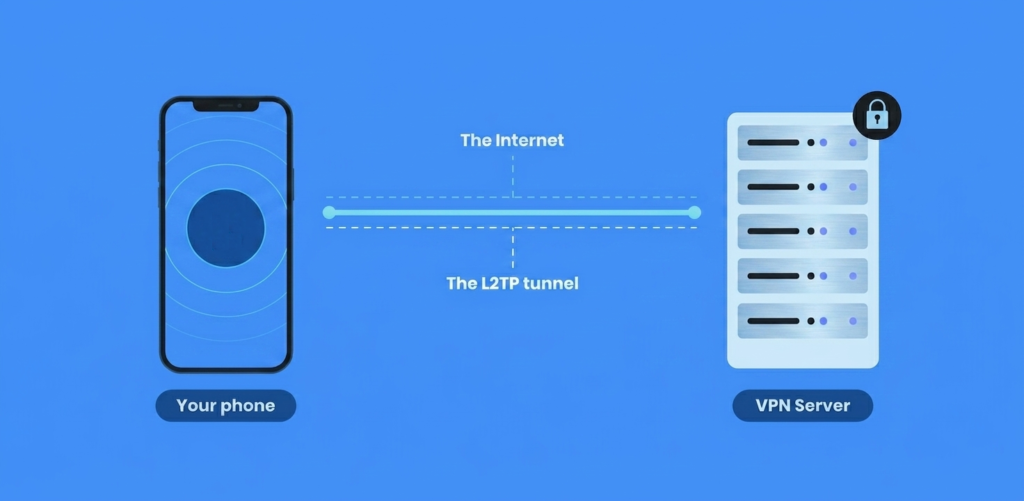
L2TP facilitates secure communication by encapsulating data packets and transmitting them through a specialized VPN tunnel established between the user’s device and a remote VPN server.
- 1 Initiation: The process begins when a user initiates a connection request to a VPN server using the L2TP protocol.
- 2 Tunnel Establishment: L2TP creates a virtual tunnel, acting as a delivery mechanism that prepares the data for transmission across the internet.
- 3 Encryption (IPsec Integration): Since L2TP lacks native encryption, the IPsec suite is employed to encrypt the data, providing the necessary security and identity authentication.
- 4 Secure Transit: The now-encrypted traffic travels through the established tunnel across the public internet, shielded from external threats.
- 5 Decryption and Delivery: Upon reaching its destination, the VPN server decrypts the payload and forwards the original traffic to the intended internal resource or website.
Note: Because L2TP does not include encryption by itself, the use of IPsec is essential for ensuring end-to-end data protection.
Key Features of L2TP
The Layer 2 Tunneling Protocol (L2TP) is distinguished by its robust tunneling capabilities, specializing in the creation of stable, virtualized tunnels that facilitate the transmission of network traffic across public infrastructures. One of its primary strengths is its exceptional cross-platform compatibility; because L2TP/IPsec is natively integrated into almost all major operating systems—including Windows, macOS, Linux, Android, and iOS—it has historically been a preferred choice for enterprise-level VPN deployments. Beyond accessibility, the protocol offers significant flexibility through its multi-protocol support, allowing it to transport diverse types of network traffic across varying environments. Furthermore, L2TP provides a comprehensive suite of authentication options, supporting methods such as PAP, CHAP, MS-CHAP, and EAP. When integrated with the IPsec framework, these capabilities are further enhanced to include certificate-based authentication, ensuring a high degree of identity verification and session integrity.
▲ Advantages of L2TP/IPsec
Strong Security with IPsec
When combined with IPsec, L2TP offers solid encryption and authentication standards that are considered secure for many enterprise applications.
Widely Supported
Most major operating systems include native support, meaning users often do not need to install additional third-party software.
Stable Connections
L2TP is renowned for maintaining reliable and consistent VPN connections across various complex network environments.
Easy Deployment
Because native support is common, configuring L2TP/IPsec is relatively straightforward for both businesses and individual users.
▼ Disadvantages of L2TP/IPsec
Slower Speeds
L2TP/IPsec utilizes double encapsulation, which significantly increases overhead and can reduce speeds compared to modern protocols.
Firewall Restrictions
Commonly uses UDP ports 500 and 4500, which are frequently targeted and blocked by restrictive firewalls or ISPs.
No Built-In Encryption
L2TP alone does not encrypt traffic; it acts only as a tunnel, making the integration of IPsec mandatory for any secure usage.
Outdated Alternatives
Newer protocols like WireGuard and OpenVPN provide better performance, improved efficiency, and much simpler modern configurations.
Is L2TP Secure?
The security of L2TP is a nuanced topic because the protocol is not inherently secure on its own, as it lacks built-in data encryption capabilities. However, when L2TP is paired with IPsec, it is generally considered to be a secure solution, provided that it is implemented and configured correctly. The overall integrity of a L2TP/IPsec connection depends heavily on several critical factors, including the use of strong encryption algorithms, the application of reliable authentication methods, and the maintenance of updated software implementations alongside a correct IPsec configuration. Despite these robust security standards, a shift is occurring in the industry; many VPN providers are now prioritizing modern protocols such as WireGuard and OpenVPN. These newer alternatives are often favored because they offer significantly improved speed and efficiency without compromising the security levels that users expect.
L2TP vs. Other VPN Protocols: A Technical Comparison
When evaluating L2TP against its predecessor, PPTP, the most critical distinctions are found in their security and reliability profiles. While both protocols share a historical lineage and boast high device compatibility, PPTP is now largely deprecated and deemed insecure due to its vulnerable encryption standards. In contrast, L2TP/IPsec offers a robust security layer through strong encryption and maintains moderate speeds, serving as a reliable alternative for legacy systems where PPTP would pose a significant security risk.
In the debate between L2TP and OpenVPN, the latter stands out for its flexibility and open-source foundation, which has earned it widespread trust within the tech community. Although both protocols deliver strong security and balanced speeds, OpenVPN is far more effective at bypassing restrictive firewalls, whereas L2TP often struggles in highly controlled network environments. While L2TP is generally easier to configure natively on most operating systems, OpenVPN remains the preferred standard for users requiring a highly adaptable and “very strong” security framework.
Ultimately, the rise of WireGuard signifies a major shift toward modern optimization, prioritizing both speed and architectural simplicity. Compared to the aging standards of L2TP/IPsec, WireGuard utilizes a lightweight code base with significantly lower complexity, resulting in exceptionally fast speeds and improved battery efficiency for mobile users. While L2TP/IPsec continues to be a secure and dependable legacy option, WireGuard is rapidly becoming the gold standard for modern VPN services due to its superior performance and cutting-edge cryptographic strength.
Technical FAQ: Layer 2 Tunneling Protocol
Q: What are the specific port requirements for L2TP/IPsec?
A: A standard L2TP/IPsec implementation requires three specific ports to be open: UDP Port 500 for IKE (Internet Key Exchange), UDP Port 4500 for NAT Traversal, and UDP Port 1701 for the L2TP traffic itself. Ensuring these are allowed through firewalls is critical for successful tunnel establishment.
Q: How does double encapsulation affect the Maximum Transmission Unit (MTU)?
A: Because L2TP/IPsec wraps data in both L2TP and IPsec headers, it adds significant overhead to each packet. This often requires reducing the MTU size (typically to 1400 or 1280 bytes) to prevent packet fragmentation, which can otherwise lead to performance degradation or connection drops.
Q: What is the role of the L2TP Access Concentrator (LAC) and L2TP Network Server (LNS)?
A: The LAC is the device that physically terminates a call or connection from a user and tunnels the traffic to an LNS. The LNS is the logical termination point of the L2TP session, where the PPP frames are decapsulated and processed for access to the internal network.
Q: Why is L2TP considered a “transparent” protocol in security audits?
A: In technical audits, L2TP is labeled transparent because it provides the tunneling structure without modifying or protecting the payload. It strictly handles the session layer movement. This is why security professionals mandate the use of IPsec to provide the cryptographic layer that L2TP lacks.
Q: Does L2TP support multi-protocol traffic beyond IP?
A: Yes. One of the distinct technical advantages of L2TP is its ability to tunnel various protocols, not just IP. Since it encapsulates PPP frames, it can transport any protocol that PPP supports, providing greater flexibility in legacy or specialized enterprise network environments.