
AES-256이란 무엇인가요? 고급 암호화 표준(AES) 완벽 가이드
AES-256, which stands for Advanced Encryption Standard with a 256-bit key length, is a highly secure symmetric encryption algorithm widely utilized to protect digital data from unauthorized access. As a symmetric cipher, it relies on a single shared secret key for both the encryption of plaintext and the decryption of ciphertext, meaning both the sender and the authorized receiver must possess this identical key to access the protected information. The standard was officially adopted by the U.S. government in 2001 following a multi-year public competition hosted by the National Institute of Standards and Technology (NIST) to find a robust successor to the aging Data Encryption Standard (DES). The winning design was based on the Rijndael cipher, an elegant block cipher developed by Belgian cryptographers Joan Daemen and Vincent Rijmen, which has since become the global benchmark for securing sensitive data across government, finance, and enterprise communications. AES Key Sizes The Advanced Encryption Standard (AES) supports three different key lengths. As the key length increases, the computational effort required to crack the encryption grows exponentially. AES-128 Standard security for general purpose protection AES-192 Enhanced security for highly sensitive data AES-256 Maximum military-grade protection Among them,AES-256 offers the highest level of security because it uses the longest key length. It provides virtually unbreakable resistance to brute-force attacks, making it the preferred standard for government, financial, and enterprise-grade security. How AES-256 Works The Advanced Encryption Standard with a 256-bit key length operates by systematically converting readable data into an indecipherable format through a series of rigorous, multi-layered mathematical operations. Rather than encrypting data all at once, the algorithm breaks the information down into fixed-size blocks of 128 bits each, which are then processed sequentially using the 256-bit secret key. To ensure maximum confusion and diffusion of the data, the cipher executes a total of 14 strict rounds of computational transformations. Each of these rounds consists of distinct cryptographic steps, including substitution, where bytes are replaced according to a predefined lookup table; permutation, which shifts rows of data to break up structures; mixing, which blends columns together to spread the influence of every bit; and key expansion, which derives unique subkeys for each individual round from the original master key. Through this repetitive and intricate scrambling process, the original plaintext is transformed into completely randomized ciphertext, making it computationally impractical to reverse-engineer or recover the source data without the exact decryption key. The core strength and global trustworthiness of AES-256 rest on its immense keyspace. Because the key is 256 bits long, it yields a total of 2^256 possible combinations, which equates to an astronomically large 78-digit number. This sheer volume of permutations creates an impenetrable barrier against unauthorized decryption, ensuring that even if all the supercomputers on Earth were paired together to launch a brute-force attack, it would still take billions of years to guess the correct key, making the algorithm effectively unbreakable with current and foreseeable computing technology. Common Uses of AES-256 The unmatched security profile of AES-256 has led to its seamless integration across a vast spectrum of modern technologies and everyday online services, serving as the invisible backbone of digital privacy. In the realm of network security, virtual private network (VPN) services rely heavily on AES-256 to establish encrypted tunnels for internet traffic, successfully preventing hackers, internet service providers (ISPs), and government surveillance systems from monitoring or intercepting user activity. Similarly, cloud storage platforms routinely deploy this standard to secure uploaded files and sensitive customer data while at rest on their servers, ensuring that data remains protected even in the event of a physical data center breach. This level of defense extends directly to personal communication, where secure messaging applications use AES encryption to shield private conversations, voice calls, and media transfers from eavesdropping. Furthermore, password managers utilize AES-256 to lock down local and cloud-based password vaults, meaning stored credentials remain completely inaccessible to unauthorized parties even if the master database is compromised. Finally, on a hardware level, modern operating systems and standalone encryption tools frequently employ AES-256 for full disk and file encryption, safeguarding entire hard drives, solid-state drives (SSDs), USB storage devices, and individual sensitive documents against local theft or unauthorized physical access. AES-256 vs AES-128 Both AES-128 and AES-256 are considered highly secure, but there are some key differences in their structure and operational characteristics. Feature AES-128 AES-256 Key Length 128-bit 256-bit Security Level Extremely High Higher Encryption Rounds 10 14 Performance Faster Slightly Slower Enterprise Usage Common Very Common While AES-128 provides more than enough security for most everyday applications, organizations handling highly sensitive data often prefer AES-256 to ensure an additional, future-proof security margin. Is AES-256 Unbreakable? While no cryptographic system is theoretically unbreakable, AES-256 is currently considered practically secure against brute-force attacks due to the unimaginable amount of computing power and time required to guess every possible key variation. Attempting to crack this standard by sheer force is computationally impossible with current technology, meaning it would take modern supercomputers billions of years to exhaust the keyspace. Looking ahead, emerging technologies such as quantum computing could eventually pose a challenge to traditional encryption methods. However, ongoing cybersecurity research indicates that AES-256 maintains strong resistance even in potential post-quantum scenarios, offering a much more durable security margin when compared to many other vulnerable cryptographic systems. Advantages & Limitations Advantages of AES-256 Strong Security Offers exceptional protection against unauthorized access and sophisticated cyberattacks. Fast Performance Despite its complexity, it is highly efficient and performs incredibly well on modern hardware. Global Standardization Internationally standardized and natively supported across almost all platforms, OS, and devices. Scalability Works seamlessly for personal use, small businesses, large enterprises, and government agencies alike. Limitations & Potential Risks Implementation Dependencies Even mathematically perfect encryption cannot protect data if configured or implemented incorrectly. The Human Element Vulnerable to human errors, weak master passwords, and social engineering attacks. Key Management Risks Poor key storage practices make it easier for attackers to steal keys directly rather than crack them. External Vulnerabilities Threats like system software exploits,
L2TP란 무엇인가요? 계층 2 터널링 프로토콜(Layer 2 Tunneling Protocol) 완벽 가이드

L2TP (Layer 2 Tunneling Protocol) is a session-layer networking protocol that serves as a fundamental building block for Virtual Private Networks (VPNs). Formally defined in RFC 2661, it operates primarily at the Data Link Layer (Layer 2) of the OSI model, though it is often carried over UDP port 1701 in modern IP networks. Its technical essence lies in its ability to encapsulate Point-to-Point Protocol (PPP) frames, allowing them to be tunneled across diverse and potentially incompatible underlying networks—such as IP, Frame Relay, or ATM—thereby extending a logical Layer 2 connection between a LAC (L2TP Access Concentrator) and a LNS (L2TP Network Server).By creating this virtualized tunnel, L2TP enables a remote client to appear as if it is physically connected to a local corporate network, regardless of its geographic location. It utilizes a control channel to manage the lifecycle of the tunnel (establishment, maintenance, and teardown) and a data channel for the actual transmission of encapsulated payloads. However, from a purely professional security perspective, L2TP is technically transparent; it provides the infrastructure for the journey but lacks built-in mechanisms for data encryption or origin authentication. Consequently, it is almost exclusively deployed in conjunction with IPsec to form the L2TP/IPsec suite, which leverages the tunneling flexibility of L2TP alongside the robust cryptographic security of the Internet Protocol Security framework. How Does L2TP Work? L2TP facilitates secure communication by encapsulating data packets and transmitting them through a specialized VPN tunnel established between the user’s device and a remote VPN server. 1 Initiation: The process begins when a user initiates a connection request to a VPN server using the L2TP protocol. 2 Tunnel Establishment: L2TP creates a virtual tunnel, acting as a delivery mechanism that prepares the data for transmission across the internet. 3 Encryption (IPsec Integration): Since L2TP lacks native encryption, the IPsec suite is employed to encrypt the data, providing the necessary security and identity authentication. 4 Secure Transit: The now-encrypted traffic travels through the established tunnel across the public internet, shielded from external threats. 5 Decryption and Delivery: Upon reaching its destination, the VPN server decrypts the payload and forwards the original traffic to the intended internal resource or website. Note: Because L2TP does not include encryption by itself, the use of IPsec is essential for ensuring end-to-end data protection. Key Features of L2TP The Layer 2 Tunneling Protocol (L2TP) is distinguished by its robust tunneling capabilities, specializing in the creation of stable, virtualized tunnels that facilitate the transmission of network traffic across public infrastructures. One of its primary strengths is its exceptional cross-platform compatibility; because L2TP/IPsec is natively integrated into almost all major operating systems—including Windows, macOS, Linux, Android, and iOS—it has historically been a preferred choice for enterprise-level VPN deployments. Beyond accessibility, the protocol offers significant flexibility through its multi-protocol support, allowing it to transport diverse types of network traffic across varying environments. Furthermore, L2TP provides a comprehensive suite of authentication options, supporting methods such as PAP, CHAP, MS-CHAP, and EAP. When integrated with the IPsec framework, these capabilities are further enhanced to include certificate-based authentication, ensuring a high degree of identity verification and session integrity. ▲ Advantages of L2TP/IPsec Strong Security with IPsec When combined with IPsec, L2TP offers solid encryption and authentication standards that are considered secure for many enterprise applications. Widely Supported Most major operating systems include native support, meaning users often do not need to install additional third-party software. Stable Connections L2TP is renowned for maintaining reliable and consistent VPN connections across various complex network environments. Easy Deployment Because native support is common, configuring L2TP/IPsec is relatively straightforward for both businesses and individual users. ▼ Disadvantages of L2TP/IPsec Slower Speeds L2TP/IPsec utilizes double encapsulation, which significantly increases overhead and can reduce speeds compared to modern protocols. Firewall Restrictions Commonly uses UDP ports 500 and 4500, which are frequently targeted and blocked by restrictive firewalls or ISPs. No Built-In Encryption L2TP alone does not encrypt traffic; it acts only as a tunnel, making the integration of IPsec mandatory for any secure usage. Outdated Alternatives Newer protocols like WireGuard and OpenVPN provide better performance, improved efficiency, and much simpler modern configurations. Is L2TP Secure? The security of L2TP is a nuanced topic because the protocol is not inherently secure on its own, as it lacks built-in data encryption capabilities. However, when L2TP is paired with IPsec, it is generally considered to be a secure solution, provided that it is implemented and configured correctly. The overall integrity of a L2TP/IPsec connection depends heavily on several critical factors, including the use of strong encryption algorithms, the application of reliable authentication methods, and the maintenance of updated software implementations alongside a correct IPsec configuration. Despite these robust security standards, a shift is occurring in the industry; many VPN providers are now prioritizing modern protocols such as WireGuard and OpenVPN. These newer alternatives are often favored because they offer significantly improved speed and efficiency without compromising the security levels that users expect. L2TP vs. Other VPN Protocols: A Technical Comparison When evaluating L2TP against its predecessor, PPTP, the most critical distinctions are found in their security and reliability profiles. While both protocols share a historical lineage and boast high device compatibility, PPTP is now largely deprecated and deemed insecure due to its vulnerable encryption standards. In contrast, L2TP/IPsec offers a robust security layer through strong encryption and maintains moderate speeds, serving as a reliable alternative for legacy systems where PPTP would pose a significant security risk. In the debate between L2TP and OpenVPN, the latter stands out for its flexibility and open-source foundation, which has earned it widespread trust within the tech community. Although both protocols deliver strong security and balanced speeds, OpenVPN is far more effective at bypassing restrictive firewalls, whereas L2TP often struggles in highly controlled network environments. While L2TP is generally easier to configure natively on most operating systems, OpenVPN remains the preferred standard for users requiring a highly adaptable and “very strong” security framework. Ultimately, the rise of WireGuard signifies a major shift toward modern
IKEv2/IPsec이란 무엇인가요? 현대적인 VPN 프로토콜에 대한 완벽 가이드

IKEv2, or Internet Key Exchange version 2, is a sophisticated, high-speed tunneling protocol that serves as the control-plane foundation for the IPsec (Internet Protocol Security) suite. Jointly developed by Microsoft and Cisco Systems to modernize and replace the original IKE standard, IKEv2 is primarily responsible for the handshake phase of a secure connection. It facilitates mutual authentication between two endpoints and negotiates the Security Association (SA), which defines the cryptographic keys and encryption algorithms that will be used for the duration of the session. While IKEv2 handles session management and tunnel maintenance, it is almost invariably paired with IPsec to form a complete VPN solution. In this partnership, IPsec functions as the data-transport layer, utilizing the Encapsulating Security Payload (ESP) to encrypt and authenticate individual data packets as they travel through the established tunnel. This synergy allows IKEv2/IPsec to offer a unique balance of high-performance throughput, industry-leading security, and exceptional stability—particularly in mobile environments where users frequently transition between different network interfaces. The Operational Mechanics of the IKEv2/IPsec Protocol The operational framework of IKEv2/IPsec relies on a layered architecture that establishes, maintains, and secures a dedicated tunnel between a client device and a VPN server. The process is divided into two primary functional phases: The Technical Architecture: How IKEv2 and IPsec Work Together The IKEv2/IPsec protocol suite operates through a specialized two-phase process, separating connection management from data transmission to ensure maximum security and performance. IKEv2: The Control Plane & Session Management IKEv2 acts as the intelligent layer of the tunnel, managing the “handshake” and session persistence through these core functions: Mutual Authentication Verifies the identity of both the client and the VPN server using digital certificates or pre-shared keys, effectively neutralizing man-in-the-middle (MITM) attacks. Security Association (SA) Negotiation Facilitates a precise agreement between the device and server on which cryptographic suites and encryption algorithms will be utilized for the duration of the session. Key Management Responsible for generating and periodically refreshing unique cryptographic keys, ensuring that the encryption remains rotating and secure. Session Resilience (MOBIKE) Leverages the Mobility and Multihoming protocol to maintain a seamless connection even when a user switches networks, such as transitioning from Wi-Fi to a cellular 5G network. Tunnel Maintenance Employs active “keep-alive” messaging and Dead Peer Detection (DPD) to monitor link health and automatically re-establish disrupted tunnels without user intervention. IPsec: The Data Plane & Payload Protection Once the secure parameters are established, IPsec takes over to safeguard the actual data flow using several protective layers: Packet-Level Encryption Utilizes the Encapsulating Security Payload (ESP) to encrypt the contents of every individual IP packet, rendering data unreadable to any unauthorized third party. Data Integrity Verification Appends a unique digital signature to each packet, ensuring the information has not been tampered with, altered, or corrupted during transit. Origin Authentication Cryptographically confirms that every received packet truly originated from the authenticated sender, preventing identity spoofing. Anti-Replay Protection Assigns sequence numbers to all data packets to prevent malicious actors from capturing and re-transmitting data to hijack a session. End-to-End Privacy Creates a comprehensive shield for all internet traffic—including application data and DNS queries—protecting it from ISP surveillance and government monitoring. Encryption Standards Used by IKEv2/IPsec The inherent security of the IKEv2/IPsec protocol is derived from its support for a diverse range of advanced encryption algorithms and cryptographic primitives. Most modern implementations prioritize the Advanced Encryption Standard (AES) with 256-bit keys (AES-256), a robust, military-grade encryption standard utilized by financial institutions and government agencies to secure top-secret data. Beyond symmetric encryption, the suite incorporates SHA-2 (Secure Hash Algorithm 2) variants to ensure data integrity and Elliptic Curve Cryptography (ECC) for efficient, high-performance public-key exchanges. In specific high-efficiency environments, IKEv2 may also leverage the ChaCha20 stream cipher, providing a modern alternative that offers high speeds on devices without hardware-accelerated AES. A critical component of a secure IKEv2/IPsec infrastructure is the implementation of Perfect Forward Secrecy (PFS). PFS ensures that the compromise of a single session or the long-term private key of the server does not jeopardize the confidentiality of past or future communications. This is achieved by generating unique, ephemeral session keys for every individual connection through Diffie-Hellman or Elliptic Curve Diffie-Hellman (ECDH) key exchanges. By ensuring that keys are never reused and are immediately discarded after a session concludes, PFS provides an essential layer of protection against retrospective decryption attacks, significantly hardening the VPN’s overall security posture. The Pros and Cons of IKEv2/IPsec The IKEv2/IPsec protocol suite is widely regarded as a premier choice for mobile users and enterprise environments due to its unique architectural strengths. Its primary advantage lies in its unparalleled connection stability; thanks to the MOBIKE (Mobility and Multihoming) extension, IKEv2 can switch between Wi-Fi and cellular networks seamlessly without dropping the VPN session. Furthermore, because IKEv2 is often implemented directly at the operating system’s kernel level, it delivers superior throughput and lower latency compared to SSL-based protocols like OpenVPN. From a security perspective, it supports the latest cryptographic suites, including AES-256 and Perfect Forward Secrecy, providing a future-proof shield against sophisticated cyber threats. Additionally, its native integration into major operating systems like Windows, macOS, and iOS simplifies deployment, often eliminating the need for third-party software. Despite its technical excellence, IKEv2/IPsec does face certain challenges, most notably in terms of firewall traversability. Because the protocol typically relies on UDP port 500 and UDP port 4500, it is more susceptible to being blocked by restrictive network administrators or national firewalls compared to protocols that can mask their traffic as standard HTTPS on TCP port 443. Furthermore, while its kernel-level integration provides a speed advantage, it also makes the protocol more complex to configure manually on the server side compared to modern, lightweight alternatives like WireGuard. Finally, although IKEv2 is highly secure, it is a relatively complex protocol with a larger codebase than newer standards, which theoretically increases the attack surface for potential vulnerabilities, though it remains one of the most trusted and audited protocols in the industry today. Is IKEv2/IPsec Safe? In the current cybersecurity landscape,
OpenVPN이란 무엇인가요? 인기 있는 VPN 프로토콜에 대한 완벽 가이드
OpenVPN is a premier open-source VPN protocol and robust software suite engineered to establish highly secure point-to-point or site-to-site connections across the public internet. Since its debut in 2001 by James Yonan, it has evolved into a global industry standard, lauded for its ability to traverse complex networks and bypass restrictive firewalls. Unlike proprietary protocols maintained behind closed doors by single corporations, OpenVPN thrives on a foundation of radical transparency. Its entire source code is open to the public, inviting continuous scrutiny, rigorous auditing, and collaborative enhancement by a worldwide community of security experts. This collective oversight ensures that vulnerabilities are swiftly addressed, cementing OpenVPN’s enduring reputation as one of the most resilient, reliable, and trusted solutions in the field of modern cybersecurity. What does OpenVPN do? OpenVPN functions as a secure tunnel builder, creating a protected path for data to travel across the often-unsecured public internet. It utilizes the SSL/TLS (Secure Sockets Layer/Transport Layer Security) protocol—the same security standard used for online banking—to encrypt all information passing between a user’s device and the VPN server. This ensures that sensitive data, such as login credentials, financial records, and personal communications, remains completely invisible to third parties, including internet service providers (ISPs), hackers, and government surveillance.OpenVPN provides critical network flexibility. It can be configured to run on any port using either UDP (User Datagram Protocol) for high-speed performance during streaming or TCP (Transmission Control Protocol) for maximum reliability and the ability to bypass strict censorship or firewalls. By masking a user’s actual IP address with that of the VPN server, it also facilitates anonymous browsing and the ability to access geo-restricted content. Whether it is connecting a remote employee to a corporate network or securing a traveler’s connection on public Wi-Fi, OpenVPN delivers a versatile, enterprise-grade solution for maintaining digital privacy and data integrity. How does OpenVPN work? OpenVPN operates by establishing a secure, encrypted tunnel between a client and a server, effectively wrapping your data in a protective layer as it travels across the internet. This process relies on a combination of advanced encryption and network protocols to ensure that information remains private, integrated, and accessible even in restrictive environments.The process begins with a handshake, where the client and server exchange security certificates or pre-shared keys to verify each other’s identity. This authentication phase uses the SSL/TLS protocol, which establishes a unique set of encryption keys for that specific session. Once the identity is confirmed, OpenVPN creates a virtual network interface—often referred to as a TUN (tunnel) or TAP (network tap) adapter—on your device. This virtual interface acts as a gateway; any data sent through it is automatically encrypted by the OpenVPN software before it ever leaves your hardware. After encryption, the data is encapsulated into standard IP packets. This is a critical step because it masks the original nature of the traffic. For example, even if you are accessing a specific website, an external observer like an ISP only sees encrypted packets traveling to an OpenVPN server. Depending on your configuration, these packets are sent via UDP for maximum speed or TCP to ensure delivery in unstable network conditions. Upon reaching the VPN server, the process is reversed: the server decrypts the packets and forwards the request to its final destination on the internet, returning the results back through the same secure tunnel. OpenVPN TCP vs UDP When choosing between transport protocols, OpenVPN offers the flexibility to use either UDP or TCP, each serving distinct networking requirements. UDP (User Datagram Protocol) is the industry default and the preferred choice for most users because it prioritizes speed and efficiency. By reducing the overhead associated with error correction, UDP delivers the low latency necessary for high-performance activities such as streaming high-definition video, online gaming, and VoIP calls. For the majority of general browsing tasks, UDP provides a smoother and more responsive experience. In contrast, TCP (Transmission Control Protocol) emphasizes reliability and guaranteed delivery over raw performance. While it is inherently slower due to its rigorous error-checking and packet-sequencing mechanisms, TCP is an essential fallback in specific scenarios. It is particularly effective for maintaining connections on unstable networks or for bypassing sophisticated firewalls that may block or throttle UDP traffic. This makes TCP an invaluable tool for users in highly restrictive environments where connectivity is prioritized over speed. Ultimately, the ability to switch between these two protocols allows for a tailored balance between performance and stability based on the user’s specific network conditions. Protocol Performance and Core Advantages When selecting a transport protocol, OpenVPN provides the flexibility to utilize either UDP or TCP, each catering to distinct networking priorities. The choice between them often dictates the balance between raw speed and connection resilience. Advantages (Strengths) Disadvantages (Limitations) Strong Security Utilizes industrial-grade AES-256 encryption trusted by experts. Performance Overhead Slower than modern protocols like WireGuard due to complex code. Open-Source Trust Publicly auditable code eliminates hidden backdoors and risks. Complex Configuration Technical setup can be challenging for non-expert users. Firewall Bypassing Can mimic HTTPS traffic on Port 443 to overcome censorship. Battery Consumption Higher power usage on mobile devices during active sessions. High Customization Offers extensive options for authentication and deployment. Legacy Architecture Larger codebase makes it more difficult to maintain than newer apps. Understanding the Protocols UDP (User Datagram Protocol) is the industry standard and the preferred choice for most users because it prioritizes efficiency. By reducing the overhead associated with error correction, UDP delivers the low latency necessary for high-performance activities such as streaming high-definition video and online gaming. For the majority of general browsing tasks, UDP provides a smoother and more responsive experience.In contrast, TCP (Transmission Control Protocol) emphasizes reliability and guaranteed delivery. While it is inherently slower due to its rigorous error-checking and packet-sequencing mechanisms, TCP is an essential fallback for maintaining connections on unstable networks or for bypassing sophisticated firewalls that may block UDP traffic. This makes TCP an invaluable tool in highly restrictive environments where connectivity is prioritized over speed. Key Advantages of OpenVPN The enduring
WireGuard VPN이란 무엇이며 어디에 사용되나요?
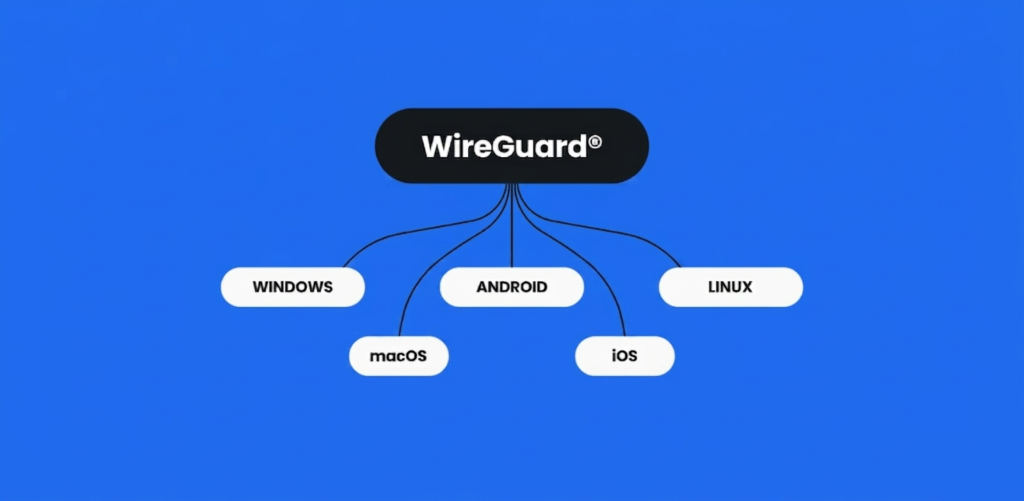
WireGuard is a cutting-edge, open-source communication protocol designed to provide a faster, simpler, and more secure Virtual Private Network (VPN) experience compared to legacy protocols like OpenVPN or IPsec. By utilizing state-of-the-art cryptography—such as the ChaCha20 cipher and Curve25519—it establishes an encrypted “tunnel” between devices, ensuring that data remains private and untamperable. Its primary use is to safeguard internet privacy and bypass geographical restrictions while maintaining high-speed performance. Because of its extremely lean codebase, WireGuard is exceptionally efficient, making it ideal for low-power mobile devices, high-speed streaming, and secure remote access for businesses, all while significantly reducing battery drain and connection latency. Which Protocols Does WireGuard VPN Use? WireGuard is built on a streamlined foundation of modern, high-speed cryptographic primitives. Unlike older VPN protocols that offer a wide “menu” of encryption options—many of which are now considered weak or outdated—WireGuard uses a fixed set of state-of-the-art protocols to ensure maximum security and performance. Key Cryptographic Foundations WireGuard utilizes a specific “opinionated” suite of protocols to eliminate vulnerabilities associated with cipher suite negotiation. These include: ChaCha20 for Symmetric Encryption: This provides high-speed encryption, particularly on mobile devices and CPUs that lack hardware acceleration for older standards like AES. Poly1305 for Message Authentication: Used in conjunction with ChaCha20, it ensures that data has not been tampered with during transmission (RFC7539). Curve25519 for Key Exchange: Utilizing Elliptic Curve Diffie-Hellman (ECDH), this protocol allows two parties to securely establish a shared secret key over an insecure channel. BLAKE2s for Hashing: Used for high-speed hashing and message authentication, outperforming older standards like SHA-3 while maintaining top-tier security. SipHash24 for Hashtable Keys: A specialized protocol used to protect against certain types of denial-of-service (DoS) attacks. HKDF for Key Derivation: Ensures the keys used for encryption are cryptographically strong and unique. By bundling these specific protocols, WireGuard avoids the complexity that often leads to security flaws in legacy systems, making it both exceptionally fast and incredibly difficult to attack. How Does the WireGuard Protocol Work? The fundamental operation of WireGuard is based on a concept called cryptographic key routing, which simplifies the way data is directed through a secure tunnel. Instead of relying on complex certificate authorities or lengthy connection negotiations, WireGuard associates a unique public key with a list of authorized internal IP addresses for each peer. When the system receives a packet, it quickly verifies the cryptographic signature against the public key and ensures the source IP matches the allowed routing table. If these do not align perfectly, the packet is silently discarded. This method allows the protocol to function with incredible efficiency, behaving more like a simple network interface than a traditional, heavy VPN service. Unlike legacy protocols that require constant communication to maintain an active state, WireGuard is designed to be virtually stateless and silent when not in use. It utilizes a highly optimized handshake that occurs in a single round-trip, allowing a secure connection to be established in milliseconds. Because it does not send unnecessary background packets to keep the tunnel open, it significantly reduces CPU usage and battery consumption on mobile devices. Furthermore, WireGuard uses UDP for all its transmissions, which avoids the performance bottlenecks and latency issues often found in older systems. This combination of streamlined key management and efficient data transport enables the protocol to provide near-native internet speeds while maintaining a nearly invisible footprint on the server side. Advantages and Disadvantages of WireGuard VPN The Pros of WireGuard WireGuard offers several significant advantages that have made it the preferred choice for modern internet users. Its most notable benefit is exceptional speed; because it operates within the system kernel and uses streamlined cryptography, it consistently outperforms older protocols like OpenVPN in both throughput and latency. Additionally, its lightweight codebase of only 4,000 lines makes it much easier for security experts to audit, significantly reducing the likelihood of hidden vulnerabilities. Mobile users also benefit greatly from its efficiency, as the protocol is designed to be silent when not transmitting data, which leads to much longer battery life on smartphones and tablets. Furthermore, its ability to handle roaming seamlessly means your connection won’t drop when switching between Wi-Fi and mobile data. The Cons of WireGuard Despite its strengths, WireGuard does have a few drawbacks that users should consider. The most frequently discussed issue is its default handling of privacy; out of the box, WireGuard is designed to store user IP addresses on the server indefinitely to facilitate its high-speed reconnection feature. While many premium VPN providers have developed custom solutions to bypass this, it is not inherently “log-free” in its raw form. Additionally, WireGuard primarily uses UDP, which can sometimes be easier for restrictive firewalls or censors in certain countries to block compared to the more flexible TCP options offered by OpenVPN. Finally, because it is a relatively newer protocol, it may lack support on older legacy hardware or specialized enterprise networking equipment that has not yet been updated to the latest standards. How to Set Up and Use WireGuard VPN Setting up WireGuard is intentionally designed to be more straightforward than legacy VPN protocols, moving away from complex certificate management in favor of simple public and private key pairs. For most users, the easiest way to get started is through a dedicated VPN service provider that supports the protocol. Within your VPN app’s settings menu, you can usually find a “Protocol” or “Connection” section where you can toggle the selection to WireGuard. Once selected, the app handles the cryptographic key generation and server handshakes automatically, allowing you to connect to a global server with a single click. This method is highly recommended for those who want the speed and security of WireGuard without needing to manage technical configurations manually. For advanced users or those setting up their own private server, the process involves installing the WireGuard software on both the host and the client device. After installation, you generate a key pair for each device using simple command-line tools. You then create a configuration file—typically ending in .conf—that defines
VPN 프로토콜이란 무엇인가요?
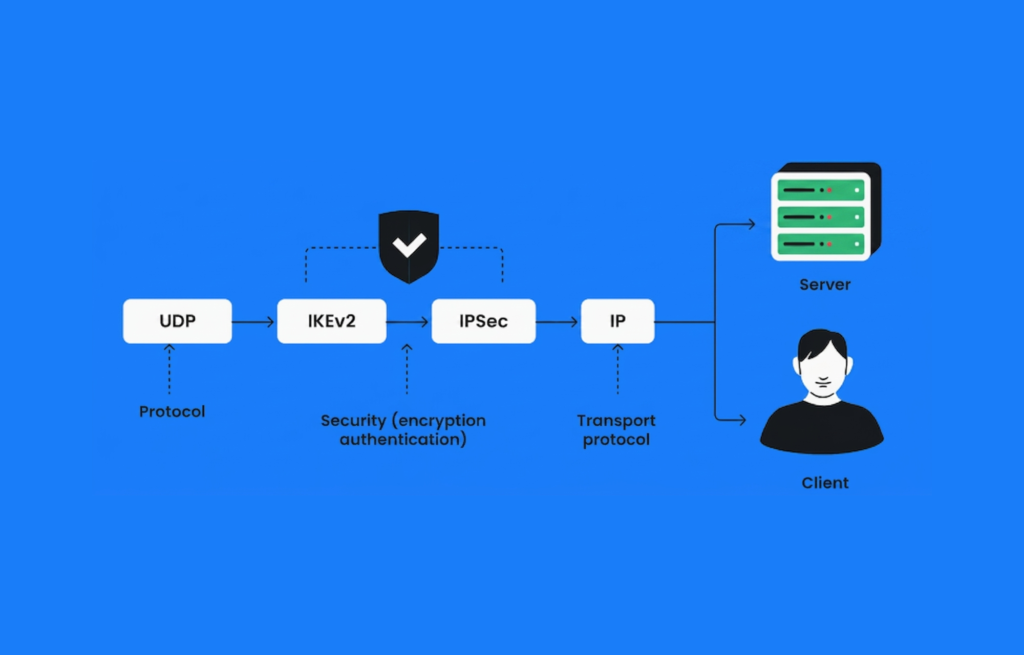
A VPN protocol is a set of standardized rules and instruction sets that determine exactly how data is transmitted between your device and a VPN server. It acts as the “instruction manual” for the secure tunnel, defining the specific methods for encryption, authentication, and data integrity. While the VPN itself creates the connection, the protocol dictates the balance between speed, security, and stability. For example, some protocols prioritize heavy encryption to ensure maximum privacy, while others focus on minimizing overhead to provide the fastest possible speeds for streaming or gaming. Common VPN Protocols Different protocols use different cryptographic techniques to handle your data. Here is a breakdown of the most widely used ones: Protocol Key Characteristics & Use Cases WireGuard The modern standard known for its lean codebase and exceptional speed. Ideal for high-performance networking and low latency. OpenVPN A highly versatile, open-source protocol that is widely considered the industry reliable standard for security and bypass capabilities. IKEv2/IPsec Excellent for mobile devices because it is highly effective at re-establishing connections when switching between Wi-Fi and cellular data. L2TP/IPsec An older protocol that is generally slower but still used for basic compatibility on legacy systems and older hardware. WireGuard: The Modern Standard for Secure Tunneling WireGuard represents a significant paradigm shift in the realm of secure networking, positioning itself as a modern alternative to aging protocols like IPsec and OpenVPN. Developed by Jason Donenfeld, its primary objective was to replace the cumbersome and bloated architectures of its predecessors with a streamlined, high-performance solution. While traditional VPN protocols often struggle with massive codebases exceeding hundreds of thousands of lines, WireGuard is famously lean, consisting of only about 4,000 lines of code. This minimalist approach is not merely an aesthetic choice but a critical security strategy; a smaller codebase presents a much narrower attack surface and allows for comprehensive independent auditing, ensuring that vulnerabilities can be identified and patched with far greater efficiency than in more complex systems. Beyond its structural simplicity, WireGuard is engineered for exceptional speed and low-latency performance. By operating entirely within the Linux kernel space and utilizing state-of-the-art cryptographic primitives, it avoids the heavy overhead typically associated with context switching in older user-space implementations. It leverages a modern “crypto suite” that includes ChaCha20 for symmetric encryption, Curve25519 for key exchange, and Poly1305 for authentication. These algorithms are designed to be extremely fast on a wide variety of hardware, even those lacking specialized AES acceleration. Consequently, users experience faster connection times, higher throughput, and improved battery life on mobile devices, making it an ideal choice for everything from high-end servers to resource-constrained smartphones.In terms of practical utility, WireGuard simplifies the often-frustrating process of VPN configuration. It adopts a straightforward public-key authentication model similar to SSH, effectively eliminating the need for managing complex X.509 certificate chains. Furthermore, the protocol is designed to be “stealthy” by default, as it does not respond to unauthenticated packets, making the server virtually invisible to unauthorized scanners. One of its most praised features is its robust roaming capability; WireGuard can maintain a seamless connection even as a device switches between different network interfaces, such as moving from a home Wi-Fi network to a cellular data connection. This combination of ironclad security, extreme performance, and ease of use has led to its rapid adoption across the industry, establishing it as the new gold standard for encrypted tunneling. The Legacy and Power of OpenVPN For nearly two decades, OpenVPN has served as the definitive industry standard for creating secure point-to-point and site-to-site connections. Released in 2001, this open-source protocol revolutionized the industry by providing a transparent and highly customizable way to secure data. Its longevity is largely due to its “battle-tested” nature; because the source code is open for anyone to inspect, it has undergone decades of rigorous independent audits. This transparency has built a level of trust that few other protocols can match, making it a favorite for privacy-conscious organizations and individual users who prioritize a proven track record over experimental speed. One of the most significant advantages of OpenVPN is its unparalleled versatility in bypassing restrictive firewalls and network censorship. Unlike many protocols that are restricted to specific ports, OpenVPN can be configured to run on both UDP for maximum speed and TCP for maximum reliability. By utilizing TCP port 443—the same port used for standard HTTPS web traffic—OpenVPN can effectively disguise VPN data as normal internet browsing. This makes it a powerful tool for users in high-censorship environments where other VPN signatures are easily detected and blocked by deep packet inspection.The security foundation of OpenVPN is built upon the OpenSSL library, which grants it access to a vast array of high-level cryptographic algorithms. It most commonly utilizes AES-256 encryption, a standard so secure it is used by governments and military institutions worldwide. Beyond simple encryption, OpenVPN supports diverse authentication methods, including digital certificates, pre-shared keys, and multi-factor authentication. While this extensive feature set allows for a high degree of “fine-tuning,” it also creates a steep learning curve. The configuration files for an OpenVPN setup are often dense and complex, requiring a deeper level of technical knowledge than modern alternatives like WireGuard. However, the weight of this versatility comes with a performance cost. OpenVPN features a massive codebase of over 100,000 lines, which is significantly more difficult to maintain and audit than newer, leaner protocols. Additionally, because OpenVPN operates in the operating system’s “user space,” it requires more CPU resources to encrypt and decrypt data, which can lead to higher latency and increased battery drain on mobile devices. Despite these drawbacks, OpenVPN remains a critical pillar of digital security, valued for its extreme flexibility, robust features, and two decades of proven reliability in the field. The Reliability and Mobility of IKEv2/IPsec IKEv2, or Internet Key Exchange version 2, is a robust tunneling protocol usually paired with IPsec for encryption and authentication. Developed jointly by Microsoft and Cisco, it has become a staple in the VPN industry due to its unique ability to maintain a persistent
RocketSpaceVPN 무료 VPN 앱

Finding a reliable VPN that is simple, fast, and free is not always easy. RocketSpaceVPN is designed for users who want a lightweight VPN app that helps improve online privacy and security without complicated setup steps or expensive subscriptions. Download RocketSpaceVPN for Free: Download on Google Play What Is RocketSpaceVPN? RocketSpaceVPN is a free VPN application that allows users to connect to secure servers and browse the internet more privately. The app helps protect online activity, especially when using public Wi-Fi networks in places like airports, cafes, hotels, or schools. The application is designed with a clean and beginner-friendly interface, making it easy for users to connect to a VPN server with just one tap. Main Features Free VPN access without subscription fees Simple and easy-to-use mobile interface Fast and stable VPN connection speeds Encrypted browsing for improved privacy Multiple server locations available Quick setup and one-tap connection Why Use a VPN? VPN apps have become increasingly popular because users want more control over their online privacy. A VPN can help reduce tracking, improve browsing security, and create a safer experience while connected to public internet networks. RocketSpaceVPN offers a simple way to access these benefits without requiring advanced technical knowledge. How to Download RocketSpaceVPN Open the Google Play Store link Download and install the app Launch RocketSpaceVPN Select a VPN server Connect and start browsing securely Official download link: https://play.google.com/store/apps/details?id=com.rocket.space.vpn RocketSpaceVPN is a practical free VPN app for users looking for a simple and accessible way to browse more securely online. With fast connections, easy installation, and free access, it provides a convenient VPN solution for everyday internet use.