
OpenVPN is a premier open-source VPN protocol and robust software suite engineered to establish highly secure point-to-point or site-to-site connections across the public internet. Since its debut in 2001 by James Yonan, it has evolved into a global industry standard, lauded for its ability to traverse complex networks and bypass restrictive firewalls. Unlike proprietary protocols maintained behind closed doors by single corporations, OpenVPN thrives on a foundation of radical transparency. Its entire source code is open to the public, inviting continuous scrutiny, rigorous auditing, and collaborative enhancement by a worldwide community of security experts. This collective oversight ensures that vulnerabilities are swiftly addressed, cementing OpenVPN’s enduring reputation as one of the most resilient, reliable, and trusted solutions in the field of modern cybersecurity.
What does OpenVPN do?
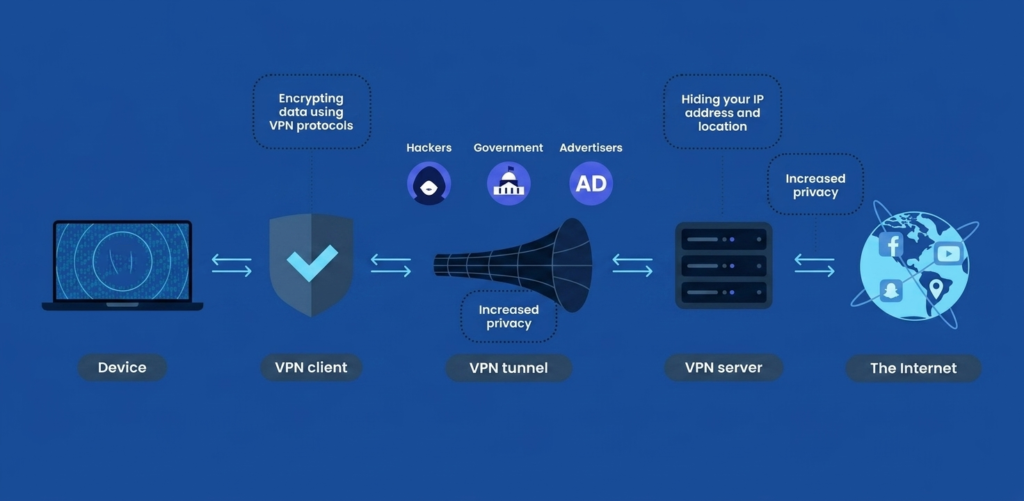
OpenVPN functions as a secure tunnel builder, creating a protected path for data to travel across the often-unsecured public internet. It utilizes the SSL/TLS (Secure Sockets Layer/Transport Layer Security) protocol—the same security standard used for online banking—to encrypt all information passing between a user’s device and the VPN server. This ensures that sensitive data, such as login credentials, financial records, and personal communications, remains completely invisible to third parties, including internet service providers (ISPs), hackers, and government surveillance.OpenVPN provides critical network flexibility. It can be configured to run on any port using either UDP (User Datagram Protocol) for high-speed performance during streaming or TCP (Transmission Control Protocol) for maximum reliability and the ability to bypass strict censorship or firewalls. By masking a user’s actual IP address with that of the VPN server, it also facilitates anonymous browsing and the ability to access geo-restricted content. Whether it is connecting a remote employee to a corporate network or securing a traveler’s connection on public Wi-Fi, OpenVPN delivers a versatile, enterprise-grade solution for maintaining digital privacy and data integrity.
How does OpenVPN work?
OpenVPN operates by establishing a secure, encrypted tunnel between a client and a server, effectively wrapping your data in a protective layer as it travels across the internet. This process relies on a combination of advanced encryption and network protocols to ensure that information remains private, integrated, and accessible even in restrictive environments.The process begins with a handshake, where the client and server exchange security certificates or pre-shared keys to verify each other’s identity. This authentication phase uses the SSL/TLS protocol, which establishes a unique set of encryption keys for that specific session. Once the identity is confirmed, OpenVPN creates a virtual network interface—often referred to as a TUN (tunnel) or TAP (network tap) adapter—on your device. This virtual interface acts as a gateway; any data sent through it is automatically encrypted by the OpenVPN software before it ever leaves your hardware.
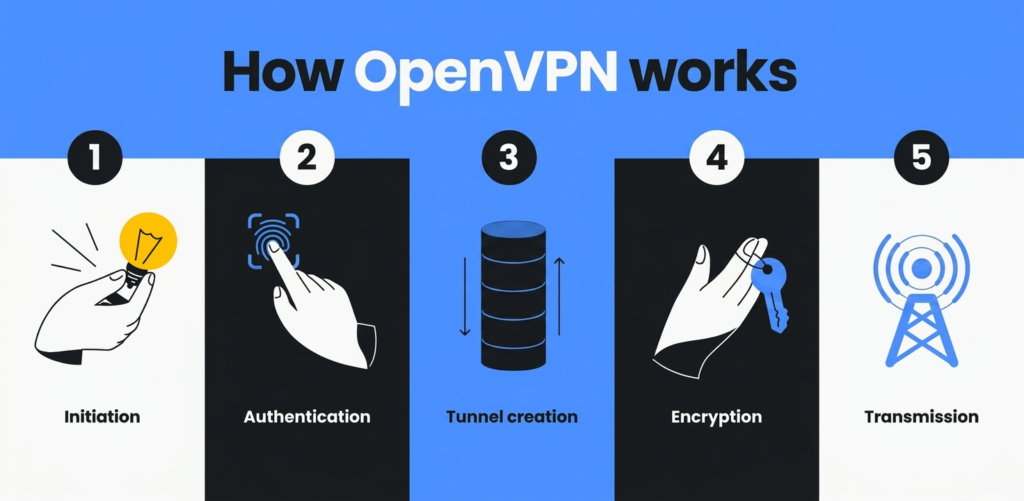
After encryption, the data is encapsulated into standard IP packets. This is a critical step because it masks the original nature of the traffic. For example, even if you are accessing a specific website, an external observer like an ISP only sees encrypted packets traveling to an OpenVPN server. Depending on your configuration, these packets are sent via UDP for maximum speed or TCP to ensure delivery in unstable network conditions. Upon reaching the VPN server, the process is reversed: the server decrypts the packets and forwards the request to its final destination on the internet, returning the results back through the same secure tunnel.
OpenVPN TCP vs UDP
When choosing between transport protocols, OpenVPN offers the flexibility to use either UDP or TCP, each serving distinct networking requirements. UDP (User Datagram Protocol) is the industry default and the preferred choice for most users because it prioritizes speed and efficiency. By reducing the overhead associated with error correction, UDP delivers the low latency necessary for high-performance activities such as streaming high-definition video, online gaming, and VoIP calls. For the majority of general browsing tasks, UDP provides a smoother and more responsive experience.
In contrast, TCP (Transmission Control Protocol) emphasizes reliability and guaranteed delivery over raw performance. While it is inherently slower due to its rigorous error-checking and packet-sequencing mechanisms, TCP is an essential fallback in specific scenarios. It is particularly effective for maintaining connections on unstable networks or for bypassing sophisticated firewalls that may block or throttle UDP traffic. This makes TCP an invaluable tool for users in highly restrictive environments where connectivity is prioritized over speed. Ultimately, the ability to switch between these two protocols allows for a tailored balance between performance and stability based on the user’s specific network conditions.
Protocol Performance and Core Advantages
When selecting a transport protocol, OpenVPN provides the flexibility to utilize either UDP or TCP, each catering to distinct networking priorities. The choice between them often dictates the balance between raw speed and connection resilience.
| Advantages (Strengths) | Disadvantages (Limitations) |
|---|---|
| Strong Security Utilizes industrial-grade AES-256 encryption trusted by experts. | Performance Overhead Slower than modern protocols like WireGuard due to complex code. |
| Open-Source Trust Publicly auditable code eliminates hidden backdoors and risks. | Complex Configuration Technical setup can be challenging for non-expert users. |
| Firewall Bypassing Can mimic HTTPS traffic on Port 443 to overcome censorship. | Battery Consumption Higher power usage on mobile devices during active sessions. |
| High Customization Offers extensive options for authentication and deployment. | Legacy Architecture Larger codebase makes it more difficult to maintain than newer apps. |
Understanding the Protocols
UDP (User Datagram Protocol) is the industry standard and the preferred choice for most users because it prioritizes efficiency. By reducing the overhead associated with error correction, UDP delivers the low latency necessary for high-performance activities such as streaming high-definition video and online gaming. For the majority of general browsing tasks, UDP provides a smoother and more responsive experience.In contrast, TCP (Transmission Control Protocol) emphasizes reliability and guaranteed delivery. While it is inherently slower due to its rigorous error-checking and packet-sequencing mechanisms, TCP is an essential fallback for maintaining connections on unstable networks or for bypassing sophisticated firewalls that may block UDP traffic. This makes TCP an invaluable tool in highly restrictive environments where connectivity is prioritized over speed.
Key Advantages of OpenVPN
The enduring popularity of OpenVPN is rooted in its sophisticated security framework, which utilizes industrial-grade encryption standards like AES-256. This level of protection is trusted by government agencies and cybersecurity experts worldwide to safeguard sensitive data against even the most advanced threats. Beyond raw encryption, the protocol’s defining strength lies in its open-source transparency. Because the source code is publicly accessible, it undergoes continuous, rigorous auditing by a global community of developers, ensuring that vulnerabilities are identified and patched rapidly.
Furthermore, OpenVPN is celebrated for its exceptional versatility. It functions seamlessly across nearly every major operating system and extending its reach to routers and enterprise networking hardware. This flexibility is complemented by its unique ability to bypass aggressive firewalls. By configuring the protocol to run on TCP port 443—the same port used for standard HTTPS web traffic—VPN connections can effectively blend in with normal internet activity. For businesses and power users, the high degree of customization remains a primary draw, providing extensive options for authentication and deployment that can be tailored to meet specific organizational needs.
OpenVPN vs Other VPN Protocols
When evaluating OpenVPN against other industry protocols, it is important to understand that each serves a different purpose within the networking ecosystem. While OpenVPN is often regarded as the most versatile and time-tested option, newer protocols like WireGuard and legacy options like IKEv2 offer different trade-offs in terms of speed, security, and mobile performance.
OpenVPN vs. WireGuard
WireGuard is the primary modern challenger to OpenVPN’s dominance. Unlike OpenVPN’s massive codebase, which consists of hundreds of thousands of lines of code, WireGuard is extremely lightweight, containing only about 4,000 lines. This simplicity makes WireGuard significantly faster and more energy-efficient, particularly on mobile devices. However, OpenVPN maintains an edge in privacy and stealth; it supports a wider variety of encryption techniques and can be easily configured to bypass restrictive firewalls by masking traffic as standard web data—a feat that is much harder to achieve with WireGuard’s fixed-protocol approach.
OpenVPN vs. IKEv2/IPSec
IKEv2 (Internet Key Exchange version 2) is widely recognized for its superior performance on mobile networks. Its primary advantage is its ability to reconnect almost instantaneously when a user switches from Wi-Fi to cellular data, making it a favorite for smartphones. While IKEv2 is generally faster than OpenVPN, it is less flexible and more susceptible to blocking by firewalls. OpenVPN remains the preferred choice for users who need a highly customizable connection that can penetrate deep packet inspection (DPI) in environments with strict internet censorship.
OpenVPN vs. Legacy Protocols (PPTP and L2TP)
Compared to legacy protocols like PPTP or L2TP/IPSec, OpenVPN is vastly superior in terms of security. PPTP is now considered obsolete due to numerous known vulnerabilities that can be exploited by hackers in minutes. While L2TP is more secure than PPTP, it lacks the sophisticated encryption agility and open-source transparency that define OpenVPN. In the modern cybersecurity landscape, OpenVPN is almost always recommended over these older protocols to ensure that data remains protected by the highest possible encryption standards.
Is OpenVPN Safe?
When evaluating whether OpenVPN is safe, it is important to consider its long-standing reputation as one of the most secure and audited protocols in existence. Its safety is not derived from a single feature, but rather from a combination of industrial-grade encryption, open-source transparency, and a proven track record of resilience against modern cyber threats.
Industrial-Grade Encryption Standards
OpenVPN is built upon the OpenSSL library, which allows it to utilize a wide range of sophisticated encryption algorithms. The most common standard is AES-256-GCM, the same level of encryption employed by financial institutions and government agencies to protect top-secret data. This ensures that even if a third party were to intercept the data packets, the information would be mathematically impossible to decipher with current computing technology. Furthermore, it supports Perfect Forward Secrecy (PFS), which ensures that even if a session key is compromised in the future, past sessions remain encrypted and secure.
The Security of Radical Transparency
Unlike proprietary VPN protocols where the source code is a closely guarded corporate secret, OpenVPN is entirely open source. This transparency is its greatest security asset. It means that the codebase is under constant, worldwide scrutiny from independent security researchers and white-hat hackers. Any potential vulnerabilities or “backdoors” are quickly identified and patched by the community, often long before they can be exploited by malicious actors. This collaborative oversight provides a level of assurance that closed-source competitors simply cannot match.
Proven Resilience and Authentication
Over its two-decade history, OpenVPN has been subjected to numerous professional third-party audits, consistently proving its architectural integrity. Beyond just hiding traffic, it offers robust authentication methods to prevent unauthorized access. This includes support for digital certificates, two-factor authentication (2FA), and smart cards. Its ability to operate over both UDP and TCP also allows it to be configured to bypass Deep Packet Inspection (DPI), making it safer for users in restrictive environments who need to maintain anonymity without being detected by sophisticated surveillance systems.
Technical FAQ & Deep Dive
Comprehensive technical insights for enterprise-grade implementation.