
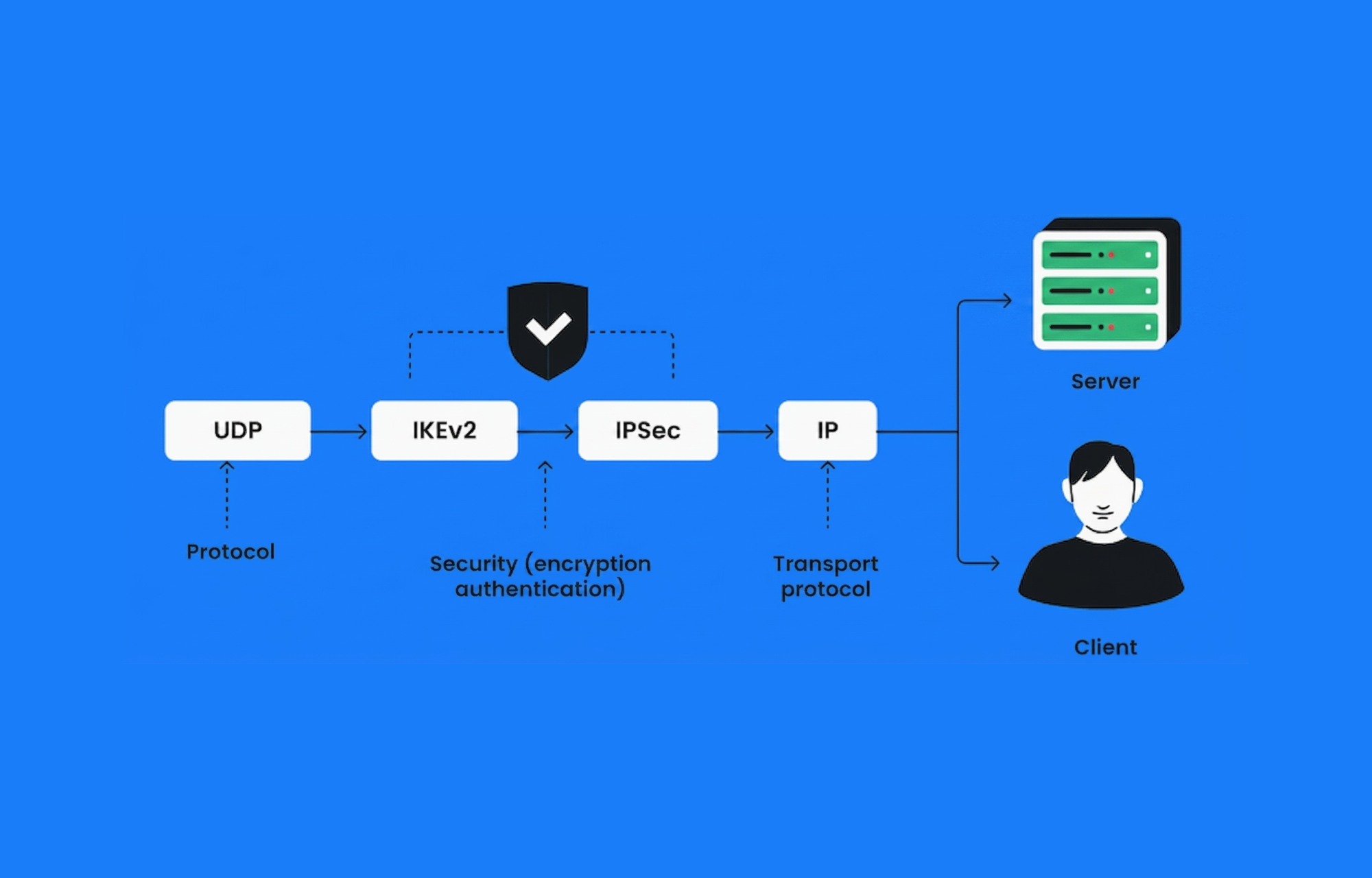
A VPN protocol is a set of standardized rules and instruction sets that determine exactly how data is transmitted between your device and a VPN server. It acts as the “instruction manual” for the secure tunnel, defining the specific methods for encryption, authentication, and data integrity. While the VPN itself creates the connection, the protocol dictates the balance between speed, security, and stability. For example, some protocols prioritize heavy encryption to ensure maximum privacy, while others focus on minimizing overhead to provide the fastest possible speeds for streaming or gaming.
Common VPN Protocols
Different protocols use different cryptographic techniques to handle your data. Here is a breakdown of the most widely used ones:
| Protocol | Key Characteristics & Use Cases |
|---|---|
| WireGuard | The modern standard known for its lean codebase and exceptional speed. Ideal for high-performance networking and low latency. |
| OpenVPN | A highly versatile, open-source protocol that is widely considered the industry reliable standard for security and bypass capabilities. |
| IKEv2/IPsec | Excellent for mobile devices because it is highly effective at re-establishing connections when switching between Wi-Fi and cellular data. |
| L2TP/IPsec | An older protocol that is generally slower but still used for basic compatibility on legacy systems and older hardware. |
WireGuard: The Modern Standard for Secure Tunneling
WireGuard represents a significant paradigm shift in the realm of secure networking, positioning itself as a modern alternative to aging protocols like IPsec and OpenVPN. Developed by Jason Donenfeld, its primary objective was to replace the cumbersome and bloated architectures of its predecessors with a streamlined, high-performance solution. While traditional VPN protocols often struggle with massive codebases exceeding hundreds of thousands of lines, WireGuard is famously lean, consisting of only about 4,000 lines of code. This minimalist approach is not merely an aesthetic choice but a critical security strategy; a smaller codebase presents a much narrower attack surface and allows for comprehensive independent auditing, ensuring that vulnerabilities can be identified and patched with far greater efficiency than in more complex systems.

Beyond its structural simplicity, WireGuard is engineered for exceptional speed and low-latency performance. By operating entirely within the Linux kernel space and utilizing state-of-the-art cryptographic primitives, it avoids the heavy overhead typically associated with context switching in older user-space implementations. It leverages a modern “crypto suite” that includes ChaCha20 for symmetric encryption, Curve25519 for key exchange, and Poly1305 for authentication. These algorithms are designed to be extremely fast on a wide variety of hardware, even those lacking specialized AES acceleration. Consequently, users experience faster connection times, higher throughput, and improved battery life on mobile devices, making it an ideal choice for everything from high-end servers to resource-constrained smartphones.In terms of practical utility, WireGuard simplifies the often-frustrating process of VPN configuration. It adopts a straightforward public-key authentication model similar to SSH, effectively eliminating the need for managing complex X.509 certificate chains. Furthermore, the protocol is designed to be “stealthy” by default, as it does not respond to unauthenticated packets, making the server virtually invisible to unauthorized scanners. One of its most praised features is its robust roaming capability; WireGuard can maintain a seamless connection even as a device switches between different network interfaces, such as moving from a home Wi-Fi network to a cellular data connection. This combination of ironclad security, extreme performance, and ease of use has led to its rapid adoption across the industry, establishing it as the new gold standard for encrypted tunneling.
The Legacy and Power of OpenVPN
For nearly two decades, OpenVPN has served as the definitive industry standard for creating secure point-to-point and site-to-site connections. Released in 2001, this open-source protocol revolutionized the industry by providing a transparent and highly customizable way to secure data. Its longevity is largely due to its “battle-tested” nature; because the source code is open for anyone to inspect, it has undergone decades of rigorous independent audits. This transparency has built a level of trust that few other protocols can match, making it a favorite for privacy-conscious organizations and individual users who prioritize a proven track record over experimental speed.
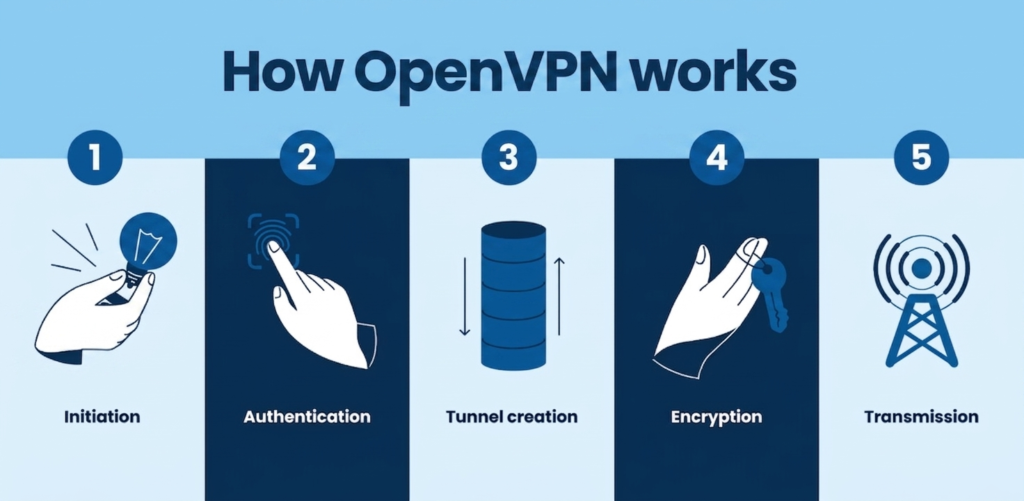
One of the most significant advantages of OpenVPN is its unparalleled versatility in bypassing restrictive firewalls and network censorship. Unlike many protocols that are restricted to specific ports, OpenVPN can be configured to run on both UDP for maximum speed and TCP for maximum reliability. By utilizing TCP port 443—the same port used for standard HTTPS web traffic—OpenVPN can effectively disguise VPN data as normal internet browsing. This makes it a powerful tool for users in high-censorship environments where other VPN signatures are easily detected and blocked by deep packet inspection.The security foundation of OpenVPN is built upon the OpenSSL library, which grants it access to a vast array of high-level cryptographic algorithms. It most commonly utilizes AES-256 encryption, a standard so secure it is used by governments and military institutions worldwide. Beyond simple encryption, OpenVPN supports diverse authentication methods, including digital certificates, pre-shared keys, and multi-factor authentication. While this extensive feature set allows for a high degree of “fine-tuning,” it also creates a steep learning curve. The configuration files for an OpenVPN setup are often dense and complex, requiring a deeper level of technical knowledge than modern alternatives like WireGuard.
However, the weight of this versatility comes with a performance cost. OpenVPN features a massive codebase of over 100,000 lines, which is significantly more difficult to maintain and audit than newer, leaner protocols. Additionally, because OpenVPN operates in the operating system’s “user space,” it requires more CPU resources to encrypt and decrypt data, which can lead to higher latency and increased battery drain on mobile devices. Despite these drawbacks, OpenVPN remains a critical pillar of digital security, valued for its extreme flexibility, robust features, and two decades of proven reliability in the field.
The Reliability and Mobility of IKEv2/IPsec
IKEv2, or Internet Key Exchange version 2, is a robust tunneling protocol usually paired with IPsec for encryption and authentication. Developed jointly by Microsoft and Cisco, it has become a staple in the VPN industry due to its unique ability to maintain a persistent connection during network transitions. Unlike older protocols that might drop a connection when a device loses a signal or switches towers, IKEv2 features a “MOBIKE” (Mobility and Multihoming) capability. This makes it exceptionally resilient for mobile users who frequently move between Wi-Fi and cellular data, as it can re-establish a secure tunnel almost instantaneously without requiring the user to manually reconnect.From a security standpoint, IKEv2/IPsec is highly regarded for its strong cryptographic support and its ability to handle high-speed data transfers. It utilizes the IPsec suite to provide a secure layer for the data packets, typically employing AES-256 encryption to ensure that intercepted data remains unreadable. One of its primary technical advantages is that it is often supported natively by many operating systems, including Windows, macOS, and iOS. This native support means that users can often set up a VPN connection using this protocol without needing to install third-party software, resulting in a cleaner and more integrated experience that places less strain on the device’s system resources.
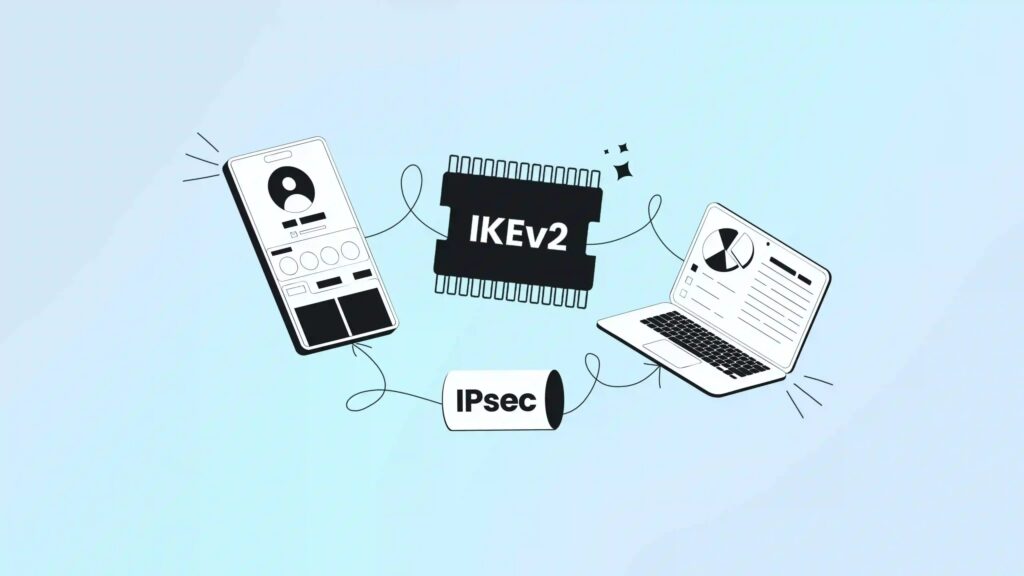
The performance of IKEv2/IPsec is generally superior to that of OpenVPN, as it is designed to be more efficient and less CPU-intensive. While it may not reach the extreme speeds of the newer WireGuard protocol, it strikes an excellent balance between security and performance, making it a top choice for high-bandwidth activities like streaming or secure corporate remote access. However, it is worth noting that IKEv2 can sometimes be easier for sophisticated firewalls to block, as it typically uses a specific set of ports that are easily identified by network administrators. Despite this, its combination of speed, native compatibility, and unmatched stability on mobile devices keeps it at the forefront of modern networking solutions.
The Compatibility and Legacy of L2TP/IPsec
Layer 2 Tunneling Protocol (L2TP) is an extension of the older Point-to-Point Tunneling Protocol (PPTP) and is almost always paired with IPsec to provide the security it lacks on its own. While L2TP creates the tunnel that allows data to travel between two points, IPsec handles the heavy lifting of encryption and authentication. This combination was for many years the standard for corporate remote access and remains a highly compatible option today. Because L2TP/IPsec is natively supported by virtually every modern operating system—from older versions of Windows to modern smartphones—it is often the go-to choice when a user needs to establish a VPN connection on a device where installing third-party software is restricted or impossible.From a technical perspective, the “double-encapsulation” process of L2TP/IPsec is its most defining characteristic. In this setup, the data is first wrapped in an L2TP packet and then wrapped again in an IPsec packet for encryption. While this provides a strong layer of protection, it also introduces significant overhead. Because every piece of data must be processed twice, L2TP/IPsec is generally slower and more CPU-intensive than leaner protocols like WireGuard or IKEv2. This can result in lower throughput and higher latency, making it less ideal for high-speed tasks like gaming or 4K streaming, though it remains perfectly adequate for standard web browsing and document sharing.
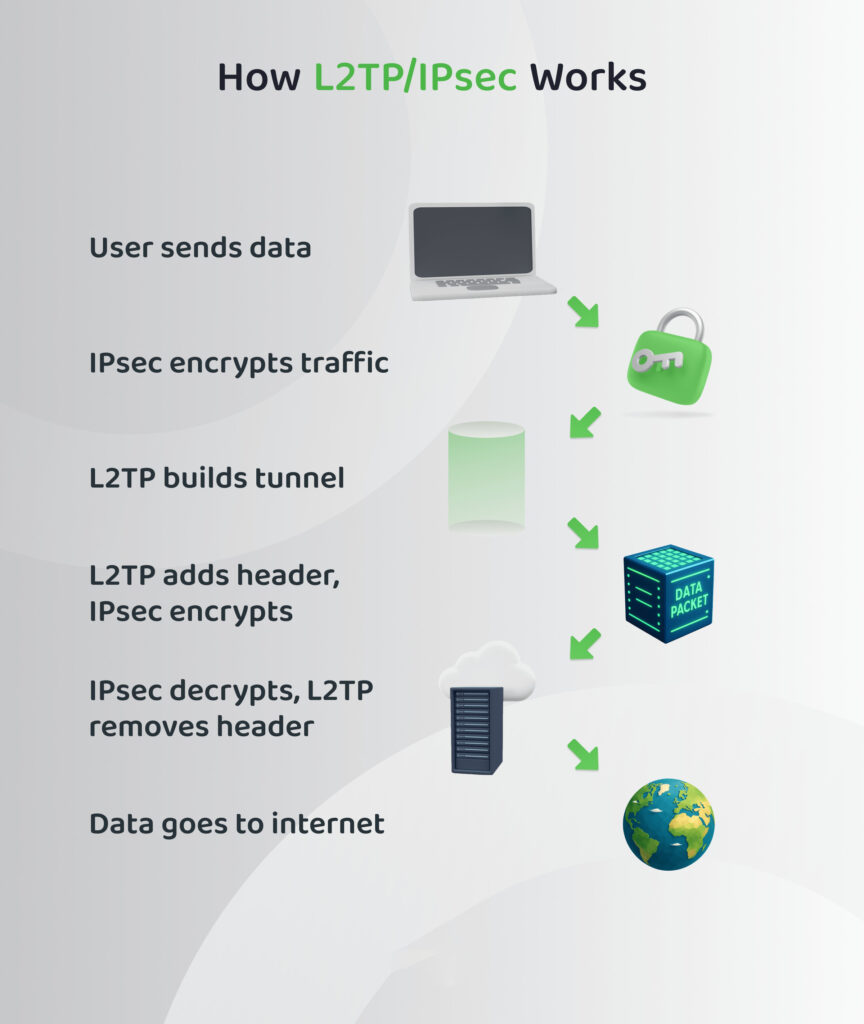
One of the primary challenges with L2TP/IPsec in the modern networking landscape is its vulnerability to being blocked by firewalls. The protocol typically relies on fixed ports, such as UDP 500 and UDP 4500, which are easily identified and restricted by network administrators or government censors using Deep Packet Inspection (DPI). Unlike OpenVPN, which can hide its traffic on common web ports, L2TP/IPsec is quite “loud” on a network and lacks stealth capabilities. Despite these limitations and its aging architecture, L2TP/IPsec continues to be used worldwide due to its universal compatibility and its status as a reliable, if slower, veteran of the VPN world.
The evolution of VPN protocols reflects the broader history of the internet itself—a constant balancing act between security, speed, and compatibility. While legacy protocols like L2TP/IPsec provide a bridge to older hardware, and OpenVPN remains the “Swiss Army Knife” for bypassing censorship, the industry is clearly moving toward a more efficient future. IKEv2/IPsec continues to be a hero for mobile users who need stability while on the move, but WireGuard has emerged as the definitive game-changer. By combining state-of-the-art cryptography with a minimalist codebase, WireGuard proves that secure networking doesn’t have to be slow or complicated.Ultimately, there is no single “best” protocol for every situation; the right choice depends on your specific hardware, your need for speed, and the level of censorship you are trying to overcome. However, understanding these “instruction manuals” of the digital tunnel allows you to take full control of your online privacy and performance.